News · Grappling
Matador partners with Combat Sports Hygiene CSH
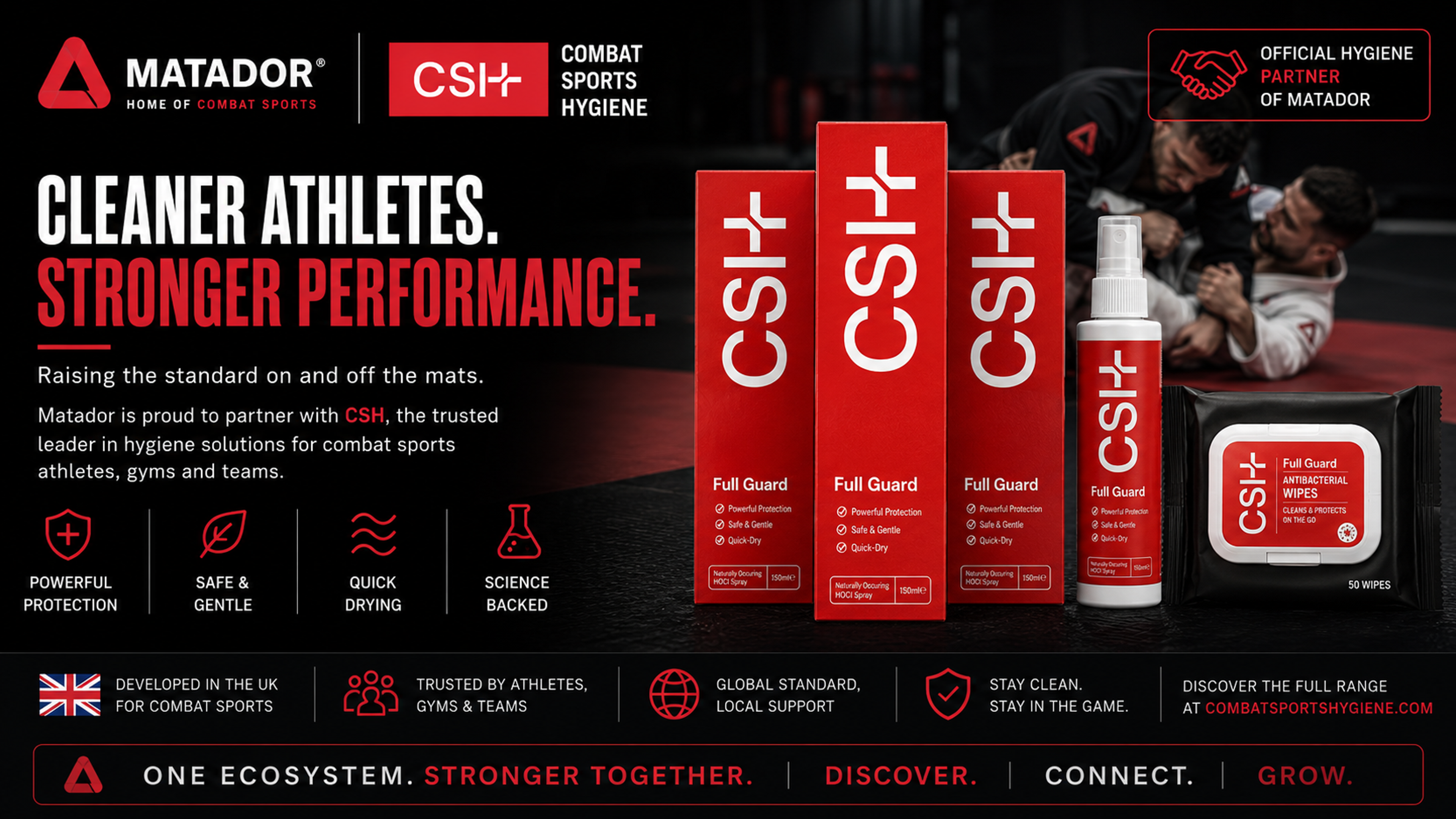
Raising the Standard: Matador Partners with Combat Sports Hygiene
In combat sports, athletes spend huge amounts of time thinking about performance. Strength and conditioning, recovery, nutrition, mobility, drilling, competition strategy - all of it matters. Yet one of the biggest threats to consistency in training is often overlooked completely: hygiene.
For years, skin infections have quietly existed in the background of grappling culture. Ringworm, staph infections, fungal outbreaks, and other mat-transmitted conditions have become so common in some gyms that many practitioners almost treat them as inevitable. But they are not inevitable - and as the sport evolves professionally, attitudes toward prevention are changing rapidly.
That shift is one of the reasons Matador partnered with Combat Sports Hygiene.
The company has built its reputation around a very specific problem: protecting athletes involved in close-contact sports where exposure to sweat, bacteria, shared surfaces, and repeated skin contact is unavoidable. Unlike general hygiene brands, Combat Sports Hygiene focuses specifically on grappling, wrestling, MMA, rugby, and other environments where skin infections spread easily.
At the centre of their range is “Full Guard,” a hypochlorous acid (HOCl) hygiene spray developed specifically for athletes training in high-contact environments. On the surface, it looks simple. But the science behind it is one of the reasons products like this are gaining traction across combat sports.
Hypochlorous acid is not a trendy chemical or harsh disinfectant created for marketing purposes. It is actually a substance naturally produced by the human immune system. White blood cells generate HOCl as part of the body’s response against bacteria, viruses, and fungi.
That distinction matters because it changes how the product behaves on the skin. Traditional antibacterial products often rely on aggressive alcohols or harsh chemicals that can dry out or irritate the skin over time. HOCl-based sprays operate differently. Research suggests they can significantly reduce microbial loads while remaining gentle enough for regular use.
Combat Sports Hygiene positions Full Guard as a higher-strength formulation than many standard HOCl sprays currently on the market. According to publicly available information from the company, the spray uses a 95% pure HOCl formulation at 300ppm potency, specifically engineered for combat sports athletes and repeated daily use.
This is where the product starts to separate itself from more general skincare or wellness sprays.
The company’s public material repeatedly references stability and purity as key differentiators. One of the biggest technical challenges with hypochlorous acid products is degradation. HOCl naturally breaks down over time, especially when exposed to light, heat, contaminants, or unstable packaging. Many lower-grade sprays lose effectiveness quickly because maintaining stable HOCl concentrations is difficult.
Combat Sports Hygiene claims its formulation was specifically engineered to remain stable and highly potent over a longer shelf life, while also avoiding unnecessary additives and irritants.
The medical and scientific context around HOCl is also becoming increasingly difficult to ignore.
A 2024 in vitro antimicrobial study examining 200ppm HOCl solutions found reductions of up to 99.99% in bacterial loads within seconds of exposure, alongside strong reductions in fungal and viral presence. The same research highlighted HOCl’s broad-spectrum antimicrobial properties and its effectiveness against organisms commonly associated with infections.
While this specific research was conducted in an ocular hygiene setting, the wider implications are relevant for contact sports. Grappling environments are exactly the type of spaces where bacterial and fungal transfer occur repeatedly through mats, sweat, and skin-to-skin contact.
Combat Sports Hygiene also appears to be leaning heavily into medical oversight and research credibility. Publicly listed advisors include professionals in infectious disease, microbiology, dermatology, and sports medicine. That is an important distinction in a market increasingly flooded with generic “combat athlete” products built more around branding than science.
The timing of this partnership also reflects where the sport itself is heading.
As Brazilian Jiu-Jitsu, MMA, wrestling, and submission grappling continue to professionalise, expectations around gym standards are rising. Practitioners are becoming more aware of how much hygiene affects consistency in training. Missing two weeks due to an avoidable skin infection is no longer viewed as “part of the game.” It is viewed as preventable downtime.
That mindset shift is already happening inside gyms.
Athletes are carrying sprays in their bags. Coaches are implementing stricter mat-cleaning policies. Academies are becoming more proactive about education and prevention rather than simply reacting once outbreaks happen.
This is where Matador’s partnership with Combat Sports Hygiene makes sense strategically.
The platform already connects athletes, practitioners, gyms, events, streaming, and instructionals. Hygiene sits naturally inside that ecosystem because it directly impacts participation and continuity. If athletes cannot train consistently, the rest of the system breaks down around them.
Rather than treating hygiene as a side concern, the partnership positions it as part of modern combat sports infrastructure - just like recovery, nutrition, and injury prevention.
And in many ways, that reflects the broader evolution of grappling itself.
The sport is no longer operating purely on old-school mentality and improvised systems. It is becoming more organised, more informed, and more professional. Products backed by research, medical oversight, and athlete-specific development are becoming part of that shift.
Combat Sports Hygiene is positioning itself directly inside that movement.
And for Matador, the partnership reinforces something larger than a single product line. It reinforces the idea that the future of combat sports is not just about finding events or watching matches. It is about building a complete ecosystem around the athlete experience - on and off the mats.
Explore the full Combat Sports Hygiene range at Combat Sports Hygiene.