News · Grappling
Roy Dean BJJ Seminar Guide: The Art of Jiu-Jitsu, Flow, and Longevity
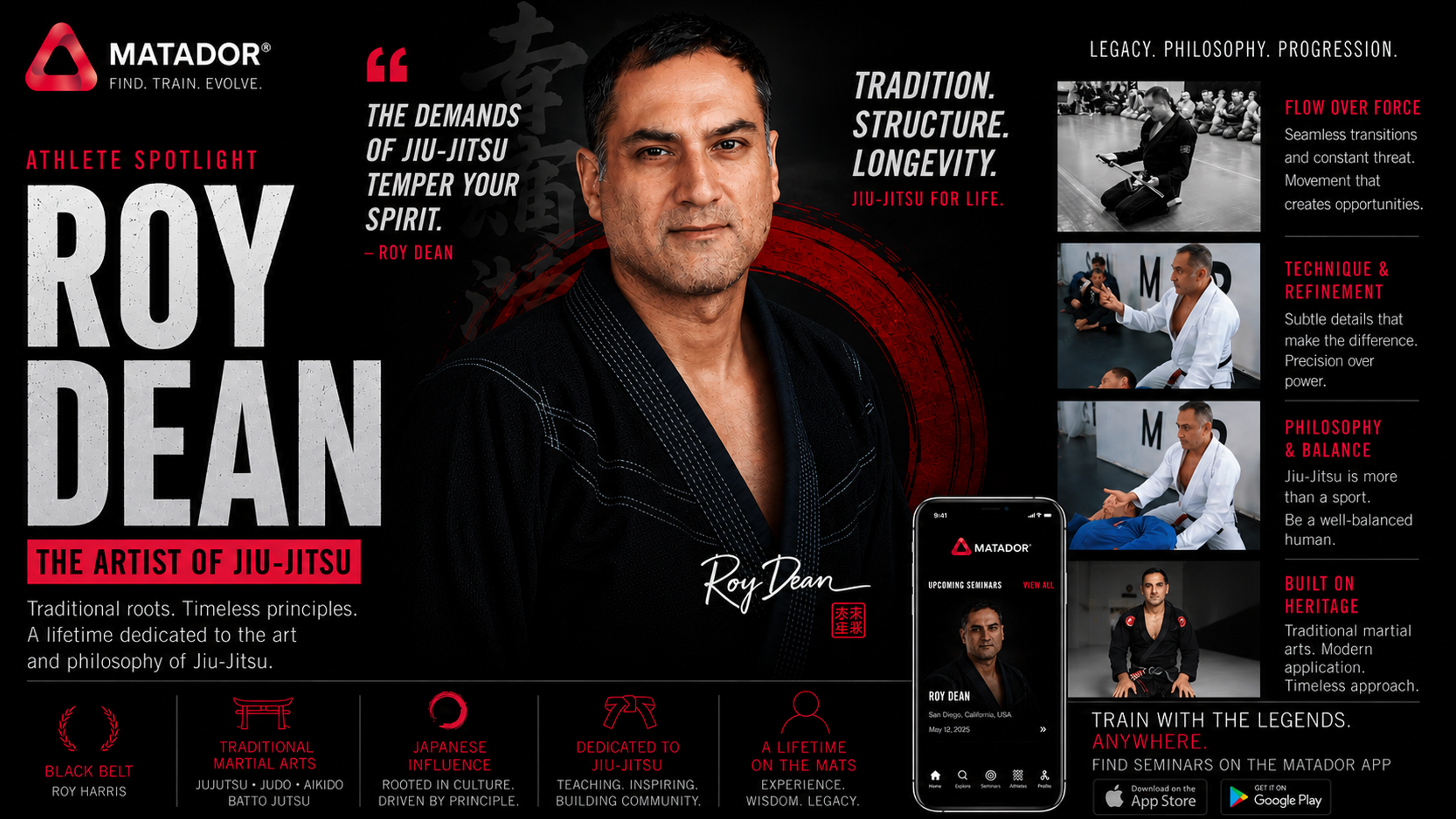
In a grappling landscape increasingly dominated by speed, athleticism, and complex no-gi systems, Roy Dean represents something very different - a connection to the deeper structure, philosophy, and longevity of martial arts itself.
While many modern instructors focus purely on competition outcomes, Dean’s approach sits at the intersection of traditional martial arts culture and Brazilian Jiu-Jitsu. His seminars are not simply about techniques. They are about movement, refinement, timing, and understanding how jiu-jitsu fits into a practitioner’s life over decades, not just tournament seasons.
That distinction is what makes him so unique in today’s landscape.
A Martial Artist Before Jiu-Jitsu
Unlike many modern BJJ instructors who came exclusively through competitive grappling, Roy Dean’s background is deeply rooted in traditional Japanese martial arts.
Before becoming known in Brazilian Jiu-Jitsu, Dean had already earned black belts in:
- Seibukan Jujutsu
- Kodokan Judo
- Aikikai Aikido
- Enshin Itto Ryu Batto Jutsu (Japanese sword art)
This heritage matters because it fundamentally shaped how he approaches jiu-jitsu today.
The Japanese Influence on His Jiu-Jitsu
Dean spent part of his youth in Japan as an exchange student, where he began training in Judo after school.
In interviews, he described how this exposure to Japanese martial arts culture influenced the rest of his journey:
“It was definitely a progression.”
That progression eventually led him into Brazilian Jiu-Jitsu under Claudio França before later receiving his black belt from Roy Harris.
What separates Dean from many modern instructors is that his jiu-jitsu still carries traces of:
- traditional martial structure
- Japanese movement principles
- efficiency over explosiveness
- timing over force
You can feel this almost immediately during his seminars.
Why Roy Dean Feels Different from Modern Grappling Instructors
Modern no-gi instruction often focuses on:
- hyper-specialisation
- competition systems
- layered sequences
- aggressive pace
Roy Dean’s teaching is almost the opposite.
Flow Over Force
During Matador’s Fight Camp, Dean focused heavily on transitions between attacks, escapes, and control positions rather than isolated submissions.
The emphasis was not:
“Finish this move.”
It was:
“Remain dangerous while moving.”
Attendees drilled:
- flowing between attacks
- escaping while threatening
- maintaining calm under pressure
- moving efficiently without overcommitting
This philosophy aligns heavily with concepts seen in Aikido and traditional Jujutsu, where movement and timing are often prioritised above brute force.
The Invisible Side of Jiu-Jitsu
One of the most interesting aspects of Roy Dean’s philosophy is his focus on what he calls the “invisible” elements of martial arts.
Beyond Physical Technique
In discussions around martial arts philosophy, Dean has repeatedly spoken about the psychological and emotional side of training.
He stated:
“The demands of jiu-jitsu temper your spirit.”
This idea appears consistently throughout his seminars and instructional content. Rather than treating jiu-jitsu purely as combat, he often frames it as:
- self-development
- refinement
- discipline through adversity
This is one of the reasons his content resonates so strongly with practitioners who remain in the sport long term.
Longevity as a Core Principle
One of the standout moments from Dean’s seminar at Matador Fight Camp was his emphasis on longevity in the sport.
Training for Decades, Not Seasons
Modern grappling culture can often feel disposable:
- hard sparring
- injury cycles
- burnout
- constant intensity
Dean’s perspective is very different.
In a recent discussion on longevity in BJJ, he explained:
“Be a well-balanced human.”
He also warned against allowing jiu-jitsu to completely consume a person’s identity:
“Never step over the line and serve the art exclusively.”
That mindset is increasingly rare in modern grappling culture.
Instead of glorifying damage and burnout, Dean promotes:
- sustainability
- technical efficiency
- mental resilience
- balance outside the gym
This philosophy is especially relevant as more practitioners continue training into their 40s, 50s, and beyond.
What You Learn at a Roy Dean Seminar
For practitioners wondering whether seminars are worth attending, Roy Dean offers a very different experience from modern competition-focused instructors.
Precision and Refinement
Rather than overwhelming attendees with volume, Dean focuses on:
- refinement of movement
- positional sensitivity
- efficient transitions
- subtle control mechanics
Many of the techniques he teaches are not flashy. They are technical details that improve overall movement quality across all areas of grappling.
Rarely Seen Techniques and Concepts
At Matador Fight Camp, attendees were exposed to techniques and positional concepts that are becoming increasingly uncommon in modern competition environments.
These included:
- flowing transition chains
- structured defensive movement
- classical grip adjustments
- movement principles rooted in older martial systems
For many attendees, this provided a completely different perspective on what jiu-jitsu can be.
The Artistic Side of Jiu-Jitsu
Another thing that separates Roy Dean from most instructors today is how cinematic and artistic his presentation of jiu-jitsu has become.
More Than Competition Footage
Dean’s instructional videos and documentaries are known for blending:
- technical instruction
- cinematic storytelling
- music
- martial philosophy
This artistic approach has helped him build a global following beyond just competitors.
For many practitioners, especially hobbyists and long-term students, his content feels closer to a martial arts journey than purely a sports instructional.
Why Roy Dean Matters in Today’s Landscape
Modern grappling has become increasingly technical and competition-oriented.
That evolution is important - but it also risks losing some of the deeper structure and philosophy that originally defined martial arts culture.
Roy Dean represents a counterbalance to that trend.
Preserving the Art Within the Sport
His approach reminds practitioners that jiu-jitsu is not only:
- about winning rounds
- collecting medals
- or mastering systems
It is also about:
- personal development
- efficiency
- longevity
- movement
- discipline
That perspective is part of why his seminars continue to resonate so strongly with practitioners around the world.
Accessing Athletes Like Roy Dean
In the past, learning from instructors like Roy Dean often required significant travel or affiliation with specific academies.
Today, platforms like Matador make it easier to discover and attend seminars with experienced martial artists and instructors from across the grappling world.
👉 Explore upcoming seminars and athlete events here:
Matador App
Final Thoughts
Roy Dean occupies a unique place in modern jiu-jitsu.
He represents a bridge between:
- traditional martial arts
- modern Brazilian Jiu-Jitsu
- philosophy
- movement
- and longevity
In a world increasingly driven by intensity and optimisation, his approach reminds practitioners that refinement, structure, and balance still matter.
For those looking to understand not only how to fight better, but how to train and evolve over decades, Roy Dean remains one of the most interesting instructors in the sport today.